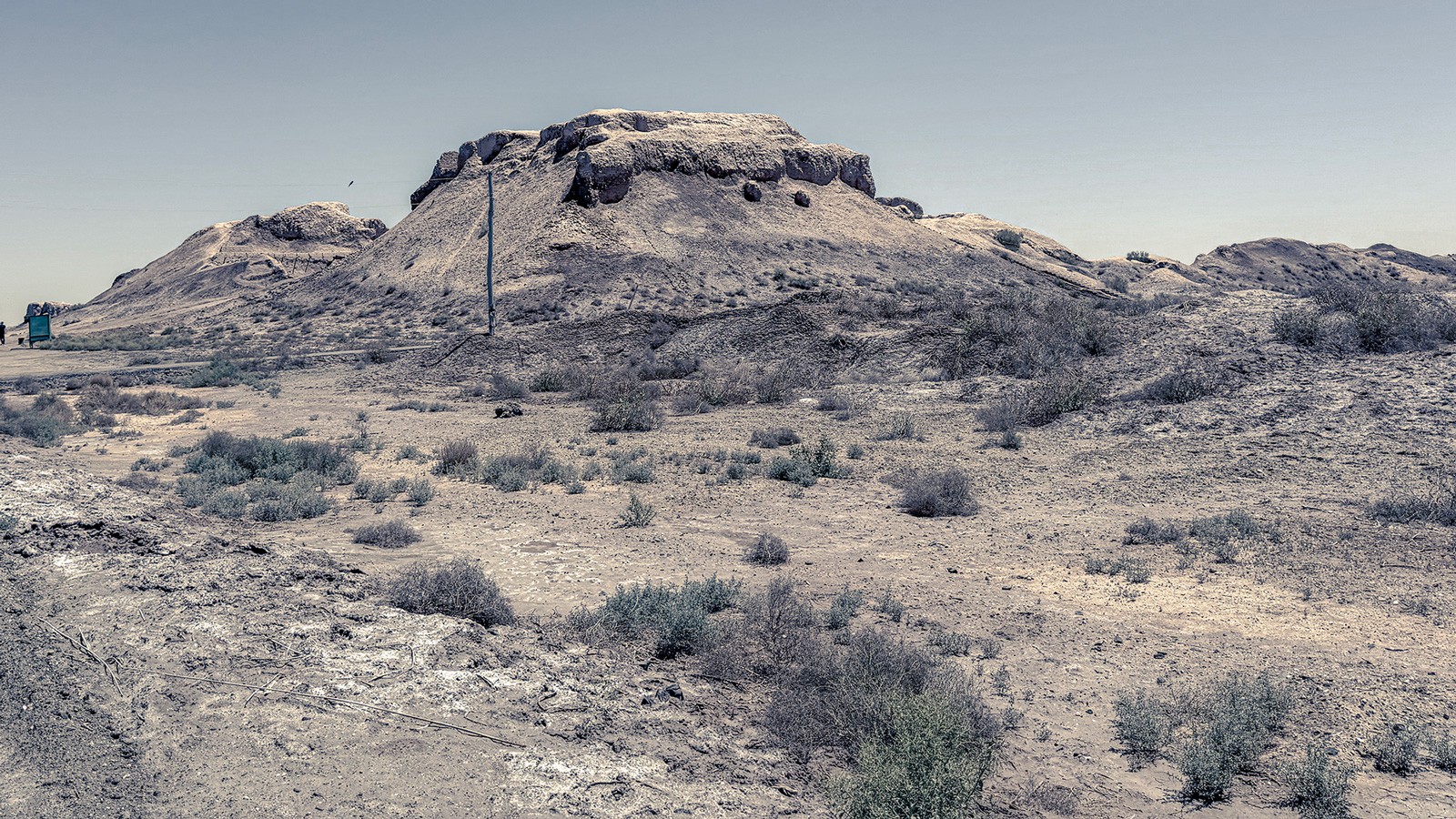
Toprak-kala远景。王城遗址在荒原中缓缓升起。
Toprak-kala: The Frontier Royal City of Khorezm
托普拉克卡拉:花剌子模边疆王城
Before the Amu Darya Changed Course, Before Khiva Emerged
在阿姆河改道之前,在希瓦出现之前
Ancient Khorezm, Uzbekistan
古代花剌子模 · 乌兹别克斯坦
From the journey back from the Caucasus, I found myself continually reflecting on the relationship between Islamic geometric patterns and spatial design.
I still remember when I first arrived in Central Asia. The dense and intricate ornamentation felt almost overwhelming. And I was certainly not the only one who felt that way. In the house we rented, the wallpaper was covered with elaborate vegetal motifs; the carpets were filled with complex geometric patterns; even the sofa cushions joined in the visual abundance. Not even the teacups were spared from this exuberant complexity. I had imagined working abroad as a kind of romantic adventure, almost like an extended holiday. Instead, my very first day became an aesthetic challenge.
Five years have passed.
I have long since grown accustomed to this richness. More than that, I have come to appreciate it—to appreciate the structures hidden within the complexity. It is precisely these structures that give stability to geometric patterns capable of extending infinitely. With these thoughts in mind, I returned to Khiva once again.
I found myself thinking of the Juma Mosque. I wanted to experience firsthand whether the logic that governs these two-dimensional geometric compositions might also have been applied to the organization of three-dimensional space.
This time, however, I did not head directly to the old city of Khiva. Instead, I first visited Toprak-kala, the royal fortress-city of ancient Khorezm.

城墙之外是草原,城墙之内曾是文明的中心
From the airport, it was a drive of one hour and nine minutes. The road passed from town streets lined with dense trees on both sides to rural roads surrounded by wild grasses. Yet neither roughness nor desolation appeared along the way.
On the journey, I came upon a blue lake. Not long after, a high earthen mound emerged from the wilderness. Looking north across the plain, beyond the edge of the barren land lay two low hills overlapping one another. Their slopes were dark, almost charred black, yet beneath the darkness lingered faint traces of green and red.
In the ancient novels of China, such a place would have been where outlaws and wandering heroes concealed themselves among the mountains. Perhaps the people of Khorezm felt something similar. They chose this place to build their royal city, gazing toward the distant hills across the plain.

墙体已经坍塌,围合关系依然清晰可辨
Not far to the north of the fortress lies a dry riverbed, pale and deeply cut into the earth. It is the Amu Darya of history.
Where there is a river, there is navigation. Along that ancient channel converged trade, taxation, military forces, grain supplies, and administrative power. Here they were gathered, managed, and distributed. This was the royal city of a civilization.
To the south stretched agricultural oases nourished by the river's waters. To the north began the vast grasslands and the world of nomads. This was also a frontier between farming and pastoral life.

拱券仍然存在,支撑它的时代已经远去
A royal city built to defend against northern enemies—this was one of the reasons the Ming dynasty established its capital in Beijing. Somehow, in the twenty-first century, that logic found an unexpected meeting point with Khorezm of the first and second centuries.
Today, little remains of the royal city except mounds of earth and fragments of arches. The mud-brick walls lie exposed beneath the sun, each brick catching the light. The cavities in the walls stand out one by one before the eye.
I could not always distinguish what belonged to antiquity and what had been restored in later times. Yet as I walked among the ruins, the intersecting lines of collapsed walls seemed to sketch the silhouettes of former inhabitants and the glow of vanished lamps.
The narrow lanes and the accumulated ruins of time evoked the bustle of merchants and travelers, as well as the grandeur of a once-powerful city-state.
Only after climbing to the highest platform did I realize that I had entered from the wrong side. The neatly constructed modern stairway for visitors, standing apart from the ruins, unexpectedly became part of my landscape.
And yet, scrambling across the rammed-earth walls and weaving through the remains of the fortress gave me something different: a physical encounter with Khorezm itself, one that seemed to bridge the distance between centuries.

废墟之中,仍然保留着通向远方的方向

废墟不是混乱,而是被时间拆开的平面图
Chinese Original Text
以下内容为作者中文原稿
────────────────
从高加索回来的路上,我一直在思考伊斯兰的平面几何与空间结构设计的关系。
记得刚来到中亚时,看到这些密集而繁复的图形真的让我窒息,并且有这个感受的不止我一人。我们租的房子里,墙布是繁复的植物纹理,地毯是繁复的几何花纹,沙发靠垫也不会落下这个热闹,甚至连茶杯都耀眼得复杂。本想着异国工作是一种度假式的浪漫,没想到第一天就成了审美的挑战。
五年过去了。
我早已习惯了这种繁复,甚至开始欣赏——欣赏它在繁复中藏着的结构。正是这些结构,让无限展开的几何图纹获得了稳定。于是我再次前往希瓦。
我想起了朱玛清真寺,想去亲身体验:这种平面结构的逻辑,是否也应用在了空间结构的操作之中。
这一次没有直奔希瓦古城,而是先去了花剌子模时期的王城要塞 Toprak-kala。
出机场,一个小时零九分钟的车程,从两侧满是浓密树木的城镇公路到周边尽是荒草的乡村公路,却也没有颠簸与贫瘠。途中遇有一片蓝色的湖。再不久,便见一座高高的土丘立于荒原之中。顺着荒原北望,荒尽处,沉睡着前后叠加的两座矮山。山色黑焦,焦中略带青红。在中国的古代小说里,那是绿林英雄藏没的地方。或许当年的花剌子模人也有类似的感应,便在此筑起王城,与远山相望。
王城北侧不远处有一条干枯的河道,略显幽深夹着贫白,那是历史中的阿姆河。遥想有河道的地方必有航运。彼时的河道、税收、商路、军队、粮食,都在这里汇集、管理与分配,这是文明的王城。城南是河流灌溉出的农耕绿洲,城北则是广阔的草原与游牧世界。这里也是农耕与游牧的边界。
筑王城以御北敌——这是明代建都北京的缘由,竟在二十一世纪与一至二世纪的花剌子模相遇了。王城如今只剩下一些堆土与少许拱券。拱券的土砖结构暴露在阳光下,颗颗闪耀;墙壁的孔洞,粒粒入目。
我分不清哪些是遗存,哪些是后来的修复。但行走其间,纵横交织的塌陷墙垣,勾勒着往日的人影与灯火;狭小的巷道与堆败的时空,渲染着旧日商旅的繁忙与城邦的雄阔。登上高台才发现,我走错了入口。那边修得整整齐齐的砖砌游览台阶,反而成了我的风景。而在夯土之间穿梭登踏,反倒让我与花剌子模有了一场跨越时空的身体亲历。
热闹了几个世纪之后,无奈河道改,城废为丘。再千载,希瓦兴。
我已无法辨认哪里是宫殿,哪里是宗教场所。只有一片热闹的混沌,在废墟中翻涌。河道改向,王朝消失,城市沦落,宗室难辨。但山还在那里。河道留下的痕迹还在那里。城与山之间的凝视关系,还在那里。这些组织空间的方式,仍有余存。王权、宗教、贸易所构筑的秩序结构,延续至今。
站在废墟之上,我忽然产生了新的疑问。
Toprak-kala 早于伊斯兰数百年。可当我俯瞰这些方格状的空间遗迹时,却不断想起后来在希瓦古城中见到的街巷与院落;想起经学院里重复展开的房间单元;想起朱玛清真寺那片由木柱构成的空间森林。它们是否属于同一种传统呢?还是说,这片土地本就存在着某种对于秩序、边界与空间组织的偏好,而不同文明只是不断赋予它新的编码?
答案我尚且不知。但在离开王城的时候,我已不再只把它看作是废墟。
它更像一个问题。一个从花剌子模延伸到希瓦,又从希瓦延伸至整个中亚的问题。
Field Notes
Location: Toprak-kala, Republic of Karakalpakstan, Uzbekistan
Date of Visit: May 2026
Travel Route: Urgench → Toprak-kala
Travel Time: Approximately 1 hour 9 minutes by car from Urgench Airport
Weather: Clear, dry steppe climate
Field Observation: Remains of the royal city, defensive walls, vaulted structures, and traces of the former Amu Darya cultural landscape.
This archive is part of an ongoing field research project.
Please credit the author when quoting or reproducing materials.
Keywords
Toprak-kala · Ancient Khorezm · Amu Darya · Khiva · Silk Road · Archaeology · Spatial History · Cultural Landscape